Meridian Hills & Williams Creek: How Town Government Shapes Real Estate
September 24, 2026
September 24, 2026
Every portal search treats them as a single upscale pocket of the north side, often hyphenated into one listing category. In reality they are two separate towns, each with its own council, its own police authority. When a buyer pulls up a "median price" for this area, that number is quietly blending two different governments, two different inventories, and two very different definitions of what a typical home even is.
Williams Creek was platted in 1925 as an exclusive community and incorporated as its own town in 1932. Meridian Hills followed in 1937. Both were later folded into the city through Indiana's 1970 Unigov consolidation, but both kept functioning local governments rather than dissolving into standard Indianapolis neighborhoods. Williams Creek operates under Indiana Code 36-3-1-11. Meridian Hills operates under a separate section, IC 36-3-2-5, which spells out that the town retains authority to levy taxes, pass its own ordinances, and appoint its own police officers.
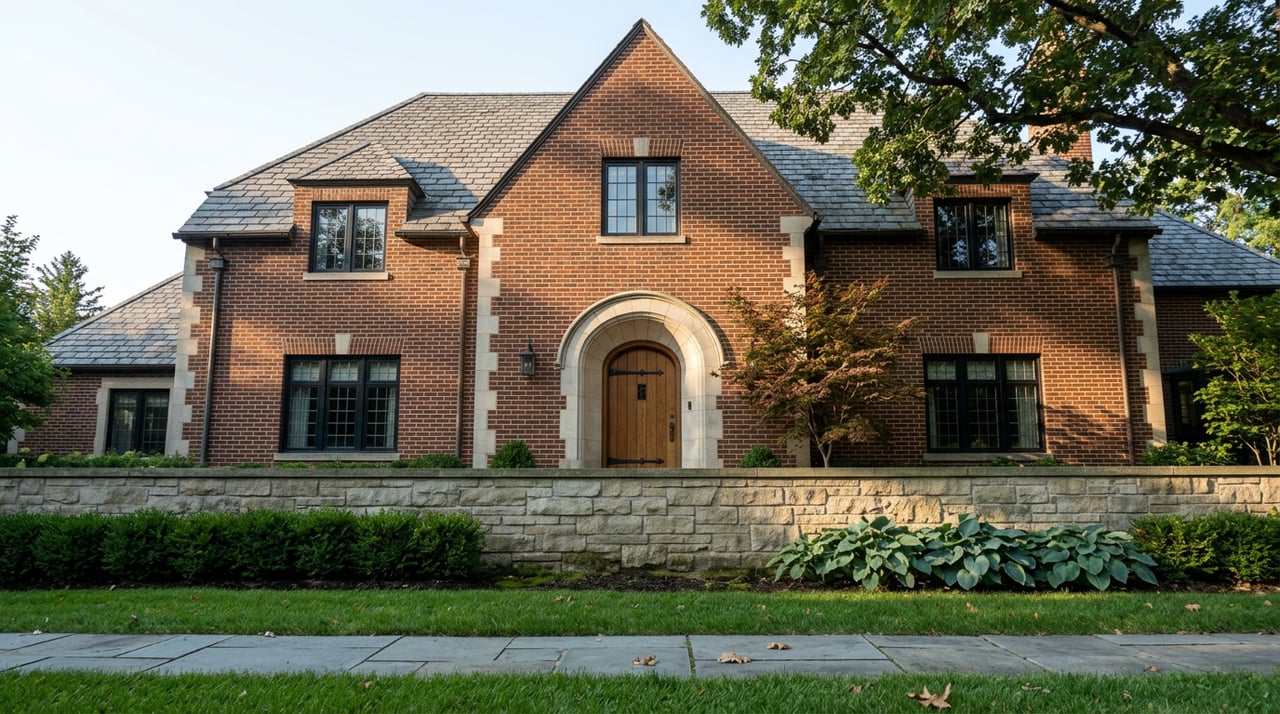
The scale of the two towns is not close. Williams Creek has roughly 163 homes and about 430 residents on land carved out between Pennsylvania Street and College Avenue, just north of Meridian Hills. Meridian Hills covers about a mile and a half square mile and holds around 715 homes and 1,800 residents. One town is a small cluster of estate lots. The other is closer to a small city.
The practical effect shows up first at the permit counter. Meridian Hills enforces its own zoning ordinance, which the town's zoning standards trace back to a 1946 town ordinance later folded into a 1957 zone map. The town's Development Standards Committee helps residents work within restrictions unique to the town.
The same independence shows up in infrastructure. Meridian Hills funds and schedules its own paving rather than waiting in line behind every other street in the city. The town's 2026 resurfacing program, contracted to Howard Companies, began June 8 and was decided entirely at the town level, paid for out of the town's own budget rather than the city's citywide queue.
Policing runs the same way. Williams Creek maintains its own Town Marshal and deputies working alongside the Indianapolis Metropolitan Police Department. Meridian Hills keeps a dedicated police administration line and describes its town government's role as supplemental protection layered on top of standard city coverage, not a replacement for it.
| Williams Creek | Meridian Hills | |
|---|---|---|
| Incorporated | 1932 (platted 1925) | 1937 |
| Governing statute | IC 36-3-1-11 | IC 36-3-2-5 |
| Homes | about 163 | about 715 |
| Residents | about 430 | about 1,800 |
| Local police | Town Marshal and deputies, alongside IMPD | Town-administered supplemental protection |
| 2026 price signal | $5,000,000 list price, the town's only active listing as of mid-September | $744,191 average home value, up 3.4 percent over the year, as of late May |
This is where the blended number falls apart. One widely used home-value tracker put the combined "Williams Creek / Meridian Hills" median at $1,012,636 earlier in 2026, a figure high enough to rank near the top of every neighborhood in the state. A separate home-value index tracking Meridian Hills on its own showed an average value of $744,191 as of late May 2026, up 3.4 percent over the prior year. Those two numbers are describing overlapping but genuinely different things, and the gap between them is not a rounding error.
The reason is inventory. Williams Creek's small stock of estate-sized homes sits at the very top of the price range, and folding even a couple of those sales into a shared "neighborhood" pulls the blended median well above what a typical Meridian Hills home is actually worth. The distortion gets more obvious the closer you look. As of mid-September 2026, Williams Creek Estates had exactly one active listing on the market, a five-bedroom home near 10,500 square feet priced at $5,000,000, averaging $474.02 per square foot and sitting for 133 days. When the entire visible market is one house, the asking price is one seller's decision, not a trend line.
A buyer comparing these two towns on an online estimate is really being shown a number that fits neither town particularly well. The underlying home counts differ by more than four to one, and the price ceiling in one town is set by a handful of estate parcels that rarely trade.
For a buyer weighing a home here against one a few blocks south in a standard Indianapolis block, the premium is not just paying for square footage or a country club a mile away. It is paying into a second layer of local government: a road budget the town controls directly, police coverage the town funds on top of the city's.
Why does Williams Creek rarely have more than one or two homes for sale at a time? Total housing stock. With only about 163 homes in the entire town, listings are naturally rare no matter how strong demand runs, which is why a single sale can swing the town's average price more than it would in a larger neighborhood.
If you're comparing a home in Meridian Hills, Williams Creek, or anywhere else on the north side and want to understand what a listed price is actually telling you, Allison Steck can walk through the numbers for your specific address. Request a Home Valuation to start the conversation.
This article is general information, not legal, tax or financial advice. Consult a qualified professional about your situation.
Stay up to date on the latest real estate trends.
Allison offers her clients both the expertise to effectively compete in the changing market, and an elevated level of service that is unmatched in the business.