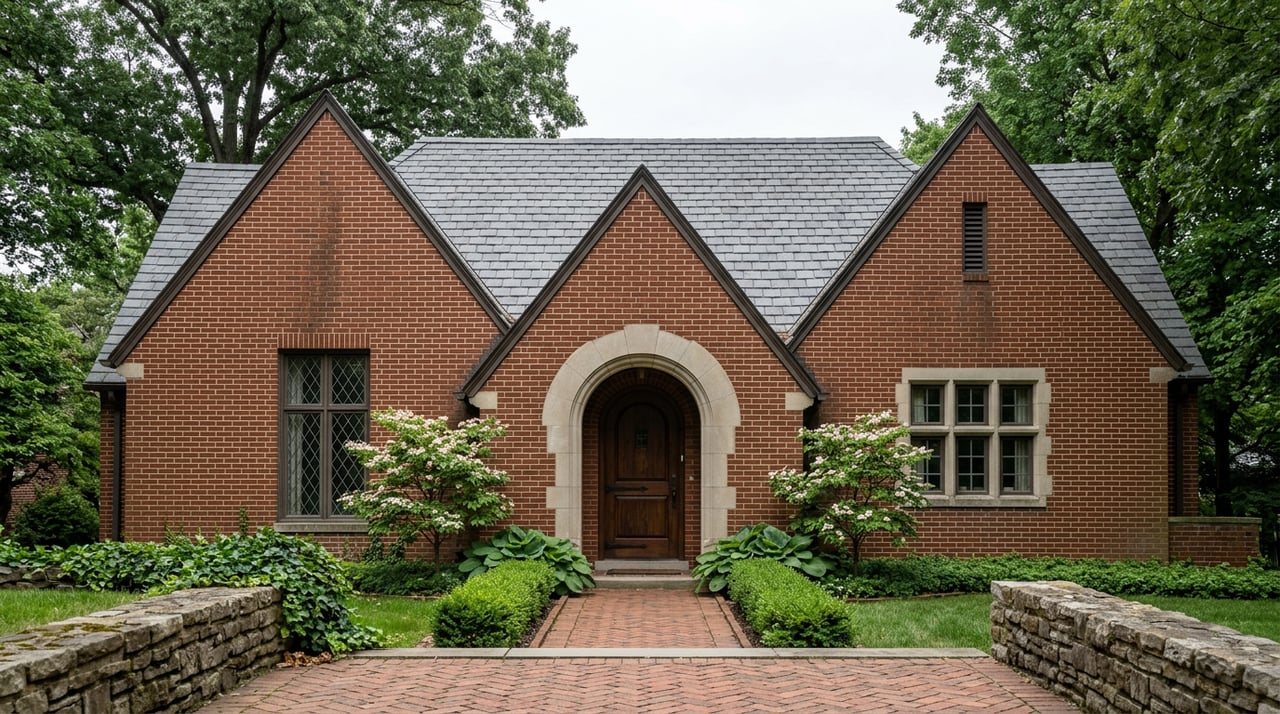
Why Some Meridian-Kessler Blocks Can Legally Be Torn Down and Others Can't
September 10, 2026
September 10, 2026
On a winter night at Bethlehem Lutheran Church on 52nd Street, a few dozen neighbors gathered to hear the Meridian-Kessler Land Use Committee work through the evening's agenda. A representative from Napolese pizzeria asked for a three-way liquor license. The owner of Fine Estate Rugs made his case for a retail shop in the old library building at 42nd and Broadway. Then the main event: a builder named Brad Litz, co-owner of Litz & Eaton Investments, stood to defend a project on 51st Street where his crew had torn a house down to the studs, clad it in cement board, and now needed a variance for an attached two-car garage. As he made his case, a Ball State architecture professor who lived across the street objected that the design had no business on a block of 1920s bungalows. The room was full of agitated homeowners. Litz's response was simple: with infill development, you're always going to run into some people who don't want to see things change.
What's easy to miss in that scene is the part nobody argued about. Litz didn't need anyone's permission to tear the house down in the first place. He needed a zoning variance for the garage, the same kind any homeowner in an ordinary Indianapolis neighborhood might need. Elsewhere in the same neighborhood, on the stretch of Pennsylvania Street that falls inside the Meridian Street Preservation District, that same demolition would have required a Certificate of Appropriateness from a state-created commission before a single brick came out. Same neighborhood name on the listing. Two entirely different legal realities underneath it.
That gap is the thing worth understanding before you write an offer in Meridian-Kessler, because it's doing more to shape the neighborhood's price range than square footage or curb appeal ever will.
Meridian-Kessler contains four separate National Register of Historic Places districts. Only one of them comes with real restrictions on what an owner can do to the exterior of a building. That's the Meridian Street Preservation District, created not by the neighborhood association but by an act of the Indiana legislature. It's overseen by the Meridian Street Preservation Commission, whose members are appointed by the governor, and its authority runs along both sides of Meridian Street itself, along Pennsylvania Street within Meridian-Kessler, and along Illinois Street in neighboring Butler-Tarkington. Inside that boundary, exterior changes go through a formal review process before they happen. Outside it, they mostly don't.
The other three National Register districts inside Meridian-Kessler, Forest Hills, Oliver Johnson's Woods, and Washington Park, carry the same federal historic recognition on paper. In practice, none of them require a Certificate of Appropriateness for exterior work. They're subject to the same zoning code as any other residential block in Indianapolis. A National Register plaque documents that a district is historically significant. It doesn't hand any commission the authority to say no to a teardown.
That distinction matters because getting actual design review takes a second, separate step. A neighborhood has to petition the Indianapolis Historic Preservation Commission for local designation, and IHPC will only take on the work if there's a real showing of resident support for a plan defining what gets protected. Once that plan is adopted, IHPC regulates construction going forward. Until then, a National Register sign on the corner is a statement of pride, not a shield.
Most of Meridian-Kessler, broken across the eight zones the neighborhood association tracks, sits in neither camp. It's eligible for National Register status but has never completed the paperwork, and it has no local design review at all.
If you're comparing two similar-looking 1920s houses in Meridian-Kessler, the protection tier of each address tells you something the listing photos never will:
None of this shows up automatically on an MLS sheet. Confirming which category an address falls into means checking with the city or asking a broker who already knows the boundaries, before the inspection period, not after.
By late August 2026, active listings in Meridian-Kessler ranged from $122,500 to $1,500,000, with a median list price of $399,999 across 49 properties on the market that month. That spread isn't just luxury mansions on one end and starter bungalows on the other. It's two different markets sharing one neighborhood name. A pattern of teardown-and-rebuild activity, the kind that made builders like Litz & Eaton a fixture on the neighborhood's project rosters, has only ever been possible in the segments where no Certificate of Appropriateness is required, whether that's one of the three zoning-only National Register districts or one of the eight zones with no historic designation at all. Those rebuilds have routinely sold for between $500,000 and $1 million. Meanwhile, homes inside the Meridian Street Preservation District trade on scarcity and permanence: what you're buying there is a house that can't quietly become something else next year.
That split even shows up in how the neighborhood's median price gets reported depending on the window you measure. Over the twelve months ending in spring 2026, one widely used tracker put Meridian-Kessler's median sale price at roughly $455,000, down slightly from the year before. A tighter three-month window ending that same spring showed a different median, $483,000, up more than 6 percent year over year, from another source. Neither figure was wrong. In a neighborhood this small, with only a few hundred sales a year spread across wildly different housing stock and protection tiers, whichever handful of streets happen to close in a given window can swing the reported median in either direction. That instability isn't noise. It's a symptom of one label covering two different products.
The gap between "historic" and "protected" hasn't gone unnoticed inside the neighborhood. The Indianapolis Historic Preservation Commission has been working through a draft Interim Plan for Meridian-Kessler, aimed at slowing the loss of architecturally significant homes across the wider area, not just the three existing National Register districts. Public comment on the draft has continued through recent review cycles, and residents have pushed back on parts of it, arguing that any expanded review process needs clearer accountability before it takes on the power to block a homeowner's plans.
None of that has been finalized. If you're comparing homes in Meridian-Kessler right now, ask your agent whether the specific address you're considering falls inside the boundary the draft plan would cover, because a plan adopted after your purchase could change what you're allowed to do to your own house.
Does a National Register listing stop a neighbor from tearing their house down? No. Forest Hills, Oliver Johnson's Woods, and Washington Park are all listed on the National Register, but that status alone doesn't give any commission the power to deny a demolition or a redesign. Only the Meridian Street Preservation District and a formally adopted IHPC local plan carry that authority.
How do I find out which protection tier a specific address falls under? The city's Historic Preservation Commission maintains the record of which boundaries apply where, and it's a question worth putting to a broker who works the neighborhood regularly before you write an offer, not after.
Is the rest of Meridian-Kessler likely to get the same protection soon? There's an active draft conservation plan under public review, but it hasn't been adopted. Until it is, the current patchwork, one protected corridor, three recognized-but-unregulated districts, and eight zones with no overlay at all, is the reality a buyer or seller is working with.
Meridian-Kessler rewards the kind of scrutiny most house hunters save for the inspection report. Knowing which rules apply to a specific block, before you fall for the porch or the built-in bookcases, changes how you think about resale, renovation plans, and what the house next door might become. If you're weighing a purchase or a sale in Meridian-Kessler and want to know exactly where an address sits in this patchwork, Allison Steck can walk you through it block by block. Request a Home Valuation to start the conversation.
Stay up to date on the latest real estate trends.
Allison offers her clients both the expertise to effectively compete in the changing market, and an elevated level of service that is unmatched in the business.